
Why the Qualification Changes the Conversation
Sara holds a Diploma in Gemmology with the Gemmological Association of Australia "” the GAA. That qualification represents a specific body of knowledge: how gemstones form, how their optical properties work, what distinguishes a stone of genuine quality from one that photographs well but wears poorly. It changes what gets looked at before a stone is recommended.
Most retail jewellers source stones from a supplier catalogue and pass the description along. Sara sources independently "” from local and international dealers, from rough suppliers, from auction houses, and from estate stock "” and assesses each stone before it is ever offered to a client. The assessment happens in the studio, under a loupe and microscope, before the conversation about price begins.
Interested in a custom piece with a specific gemstone? Sara provides free consultations to discuss options "” at our Kiama boutique or via video call.
Book a ConsultationWhat Sara Looks for Under the Loupe
The first thing Sara assesses is clarity "” not in the GIA sense of a grade assigned to a certificate, but the actual distribution of inclusions within the stone. Where are they? Are they in the centre of the table where they will catch the eye, or at the edge where they will be hidden by a claw? A stone with a low clarity grade but well-placed inclusions can be a better choice for a specific setting than a higher-graded stone with inclusions at the face.
Colour Saturation and Distribution
Colour in a coloured gemstone is not uniform "” it moves through the stone in zones that reflect how the crystal grew. Sara assesses where the colour sits and how it will appear once the stone is set. A sapphire that is vivid from one angle can appear pale from another. Understanding the colour distribution before the setting is designed means the design can work with the stone's natural behaviour.
Inclusion Mapping
Every inclusion has a position, a type, and a risk profile. A fracture that runs parallel to the table in a low-impact setting is different from the same fracture running perpendicular in a ring worn daily. Sara considers inclusion placement as part of the assessment — not a formal mapping exercise, but an understanding of where the stone can be safely set and how it will wear over time.
Cut Quality and Light Return
A well-cut stone returns light efficiently "” the facets interact with incoming light and reflect it back through the table toward the eye. A poorly proportioned stone leaks light through the pavilion. Sara assesses cut performance by rotating the stone under different lighting conditions to observe how it moves. This is what Sara means by “fire” in a stone.
Origin and Treatments
Many coloured gemstones are routinely treated "” heat treatment in sapphires and rubies, oiling in emeralds. Sara identifies treatment status as part of the assessment, because we like to understand the treatment to ensure the price reflects it. It does not automatically disqualify a stone "” most blue sapphires on the market are heat-treated "” but the client should know what they are buying.
Stability and Hardness
Not every beautiful stone makes a beautiful ring. Some minerals "” opal, tanzanite, emerald "” are softer or more brittle than others and require settings designed for protection. Sara considers wearability alongside beauty when recommending a stone for a specific piece and lifestyle.
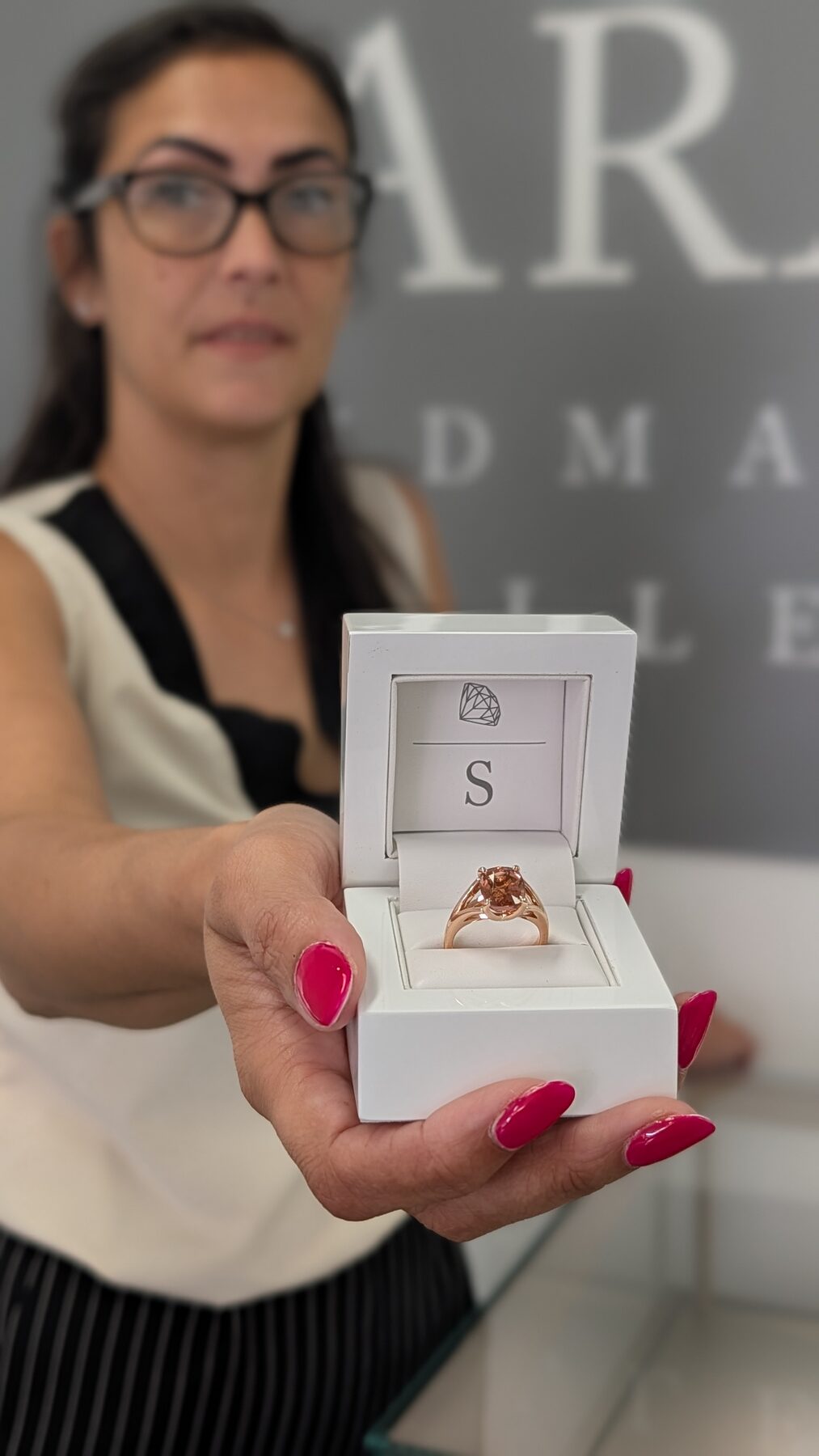
The completed piece "” a tourmaline ring, sourced from our collection and designed in Sara's Kiama studio.
Independent Sourcing Versus a Supplier Catalogue
When a client comes to Sara wanting a specific stone "” a padparadscha sapphire, a Lightning Ridge opal, a natural alexandrite "” Sara begins sourcing independently rather than pulling from a fixed supplier list. That means contacting multiple suppliers, reviewing rough and cut stones in transit, and sometimes waiting weeks for the right stone to become available.
It also means being honest when a stone at a client's budget is not up to the standard Sara would set it. Sara would rather tell a client that the stones available at a certain price point are not what she would recommend, and have that conversation openly, than proceed with a stone she is not satisfied with. That conversation happens before any deposit is taken.
Learn more about Sara's gemstone sourcing service "” the process, the supply networks, and what to expect when you commission a piece built around a specific stone.
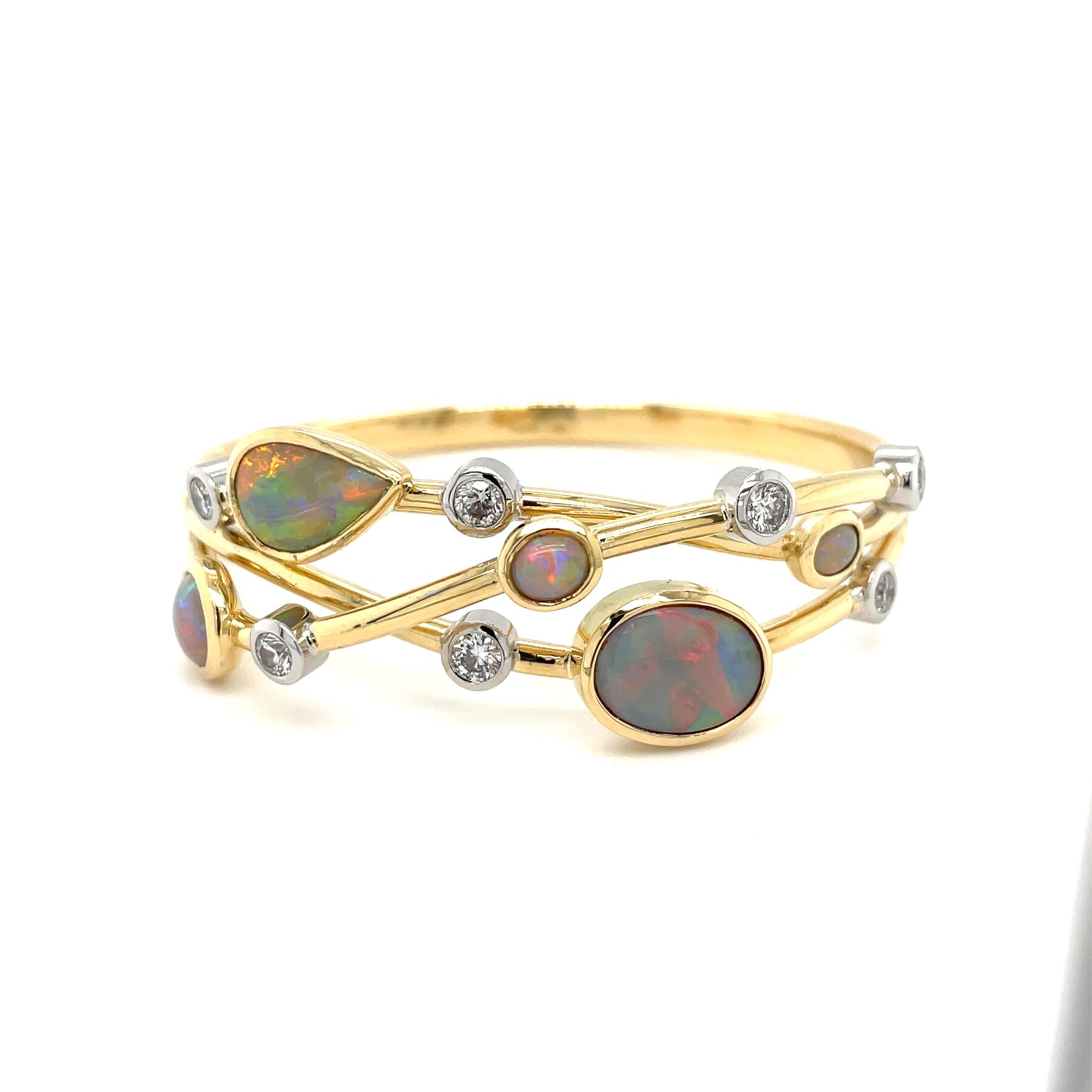
A custom gold opal and diamond bangle. The opal was repurposed from the client's brooch and necklace into a piece they would actually wear.


